Measles


  • Measles is a highly contagious, acute viral respiratory illness. It is one of the most contagious of all infectious diseases. If one person has it, up to 9 out of 10 people nearby will become infected if they are not protected.

  • Yes. In 2025, confirmed measles cases have been reported in over thirty (30) states, with 14 outbreaks being reported. CDC defines an outbreak as three (3) or more related cases. Pennsylvania is one of those states that has reported an outbreak.

    You can find CDC’s most current data on reported measles cases
  • Measles can cause serious health complications, especially in children younger than 5 years old. 

  • Common complications from measles are:
    • Ear infections occur in about 1 out of every 10 children with measles
    • Diarrhea is reported in less than 1 out of 10 people with measles
    Severe complications in children and adults:
    • Hospitalization - about 1 in 5 unvaccinated people in the U.S. who get measles is hospitalized.
    • Pneumonia - as many as 1 out of every 20 children with measles gets pneumonia; this is the most common cause of death from measles in young children.
    • Encephalitis - about 1 child out of every 1,000 who get measles will develop encephalitis (swelling of the brain); this can lead to convulsions and leave the child deaf or with intellectual disability.
    • Death - nearly 1 to 3 of every 1,000 children who become infected with measles will die from respiratory and neurologic complications.
    • Complications during pregnancy - if you are pregnant and have not had the MMR vaccine, measles may cause premature birth prematurely or a low-birth-weight baby.
    • Subacute sclerosing panencephalitis (SSPE) is a very rare, but fatal disease of the central nervous system that results from a measles virus infection acquired earlier in life.
      ✔️ SSPE generally develops 7 to 10 years after a person has measles, even though the person seems to have fully recovered from the illness.
      ✔️ Among people who contracted measles in the United States from 1989 to 1991, 7 to 11 out of every 100,000 were estimated to be at risk for developing SSPE.
      ✔️ The risk of developing SSPE may be higher for a person who gets measles before they are 2 years of age.
    Those at risk for complications:
    • Measles can be serious in all age groups. However, there are several groups that are more likely to suffer from measles complications.
      ✔️ Children younger than 5 years of age
      ✔️ Adults older than 20 years of age
      ✔️ Pregnant women
      ✔️ People with weakened immune systems
  • Measles symptoms generally appear 7 to 14 days after contact with the virus.

    Measles typically begins with:
    • High fever (may spike to more than 104°F)
    • Cough
    • Runny nose (coryza)
    • Red, watery eyes (conjunctivitis)
    2–3 days after symptoms begin:
    • Tiny white spots (Koplik spots) may appear inside the mouth
    3–5 days after symptoms begin:
    • Measles rash appears - usually begins as flat red spots that appear on the face at the hairline, then spreads downward to the neck, trunk, arms, legs, and feet.
      • ✔️Small, raised bumps may also appear on top of the flat red spots.
      • ✔️The spots may become joined together as they spread from the head to the rest of the body.
      • ✔️When the rash appears, a person's fever may spike to more than 104°F.
    5-6 days after onset of rash:
    • The rash will begin to fade in the order of its appearance
    Other Symptoms:
    • Lack of appetite
    • Swollen lymph nodes
    • Diarrhea (especially in infants)
  • Do not allow patients with suspected measles to remain in the waiting room or other common areas of the facility. Isolate them immediately and have them wear face masks if tolerable. 

    • Ensure that all providers have presumptive evidence of immunity to measles
    • ✔️ Documentation of vaccination with 2 doses of measles virus-containing vaccine (the first dose administered at age ≥12 months; the second dose no earlier than 28 days after the first dose); OR
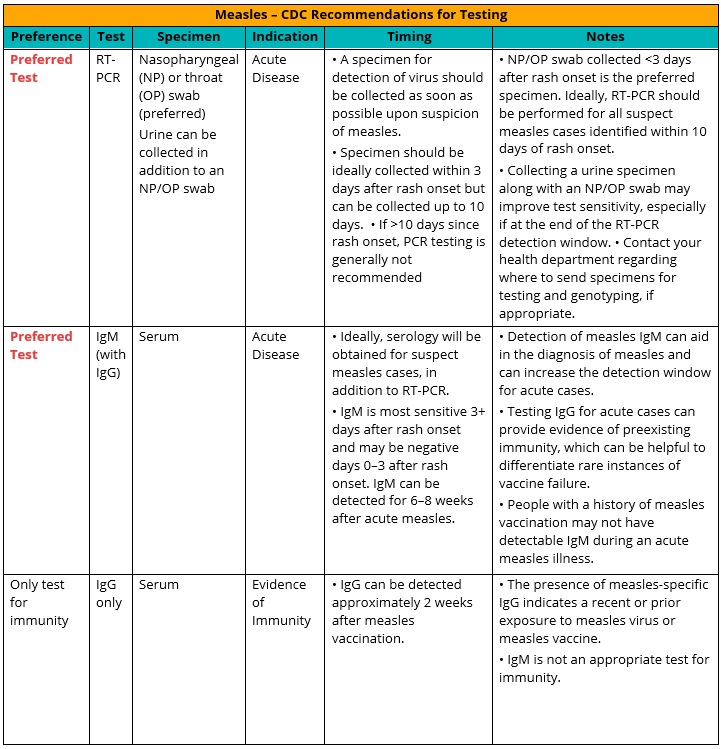
    • ✔️ Laboratory evidence of immunity (measles immunoglobulin G [IgG] in serum; equivocal results are considered negative); OR
    • ✔️ Laboratory confirmation of disease; OR
    • ✔️Birth before 1957
    • Consider vaccinating HCP born before 1957 who do not have other evidence of immunity to measles
    • During a measles outbreak, 2 doses of measles virus-containing vaccine are recommended for all HCP, regardless of year of birth.
    • Minimize potential measles exposures
    • ✔️ Persons with signs or symptoms of measles should be identified, provided a face mask to wear, and separated from other patients prior to or as soon as possible after entry into a facility
    • ✔️ Post visual alerts (e.g., signs, posters) about respiratory hygiene, cough etiquette, and hand hygiene at the facility entrance and in common areas
    • ✔️Make supplies to perform hand hygiene available
    • ✔️ Provide supplies (e.g., facemasks) near the visual alerts if possible
    • Implement environmental infection control
    • ✔️ Standard cleaning and disinfection procedures (e.g., using cleaners and water to pre-clean surfaces prior to applying disinfectants to frequently touched surfaces or objects for indicated contact times) are adequate for measles virus environmental control in all healthcare settings
    • ✔️ Use an EPA-registered disinfectant for healthcare settings, per manufacturer's instructions
    • ✔️ Manage used, disposable PPE and other patient care items for measles patients as regulated medical waste according to federal and local regulations
  • Measles is a highly contagious virus that lives in the mucus in the nose and throat of an infected person. It can spread to others through coughing and sneezing. If other people breathe the contaminated air or touch the infected surface, then touch their eyes, nose, or mouth, they can become infected.

    The virus can live for up to two hours in an airspace.

  • An infected person can spread measles to others even before knowing they have the disease. Measles can be spread to others from 4 days before through 4 days after the rash appears.

    Up to 90% of the people who are not immune and are close to someone with measles will also become infected.  

  • The best way to protect against measles is with the measles, mumps, and rubella (MMR) vaccine. MMR is safe and effective. Most people who are vaccinated with MMR will be protected for life. Two doses of MMR vaccine are about 97% effective at preventing measles; one dose is about 93% effective.

  • Two doses of MMR vaccine are about 97% effective at preventing measles (recommended); one dose is about 93% effective.

  • There are two vaccines that protect against measles, mumps, and rubella.
    • Measles, Mumps, and Rubella – MMR
    • ✔️ Two MMR vaccines are available for use in the United States: M-M-R II and PRIORIX.
    • Both are recommended similarly and considered interchangeable.

    Children need 2 doses of MMR vaccines:

    12-15 months old – 1st dose

    4-6 years old – 2nd dose

    • Measles, Mumps, Rubella, and Varicella – MMRV
    • ✔️ This vaccine is only licensed for use in children who are 12 months through 12 years of age.

    Children need 2 doses of MMR vaccines:

    12-15 months old – 1st dose

    4-6 years old – 2nd dose (can also be given 3 months after 1st dose)

  • Yes, some people should not get the MMR vaccine, or they should wait. Individuals should check with their health care provider before being vaccinated for measles if they:
    • Have had an allergic reaction after a previous dose of MMR or MMRV vaccine, or have any severe, life-threatening allergies
    • Are or may be pregnant. Wait to get MMR vaccine until after you are no longer pregnant. Avoid getting pregnant for at least 1 month after getting MMR vaccine.
    • Have a weakened immune system due to disease or medical treatments; or have a family member with a history of immune system problems
    • Have ever had a condition that makes them bruise or bleed easily.
    • Have recently had a blood transfusion or received other blood products.
    • Have tuberculosis.
    • Have gotten any other vaccines in the past 4 weeks.
    • Are feeling unwell or severely ill.
    • Have a history of seizures, or has a parent, brother, or sister with a history of seizures.
    • Are taking or plan to take salicylates (such as aspirin)
  • Most people don't have any side effects from the vaccine. The side effects that do occur are usually mild, and may include:
    • Soreness, redness, or swelling where the vaccine was given
    • Fever
    • Mild rash
    • Temporary pain and stiffness in the joints

    More serious side effects are rare but may include high fever that could cause a seizure.